 The Bitcoin Annotated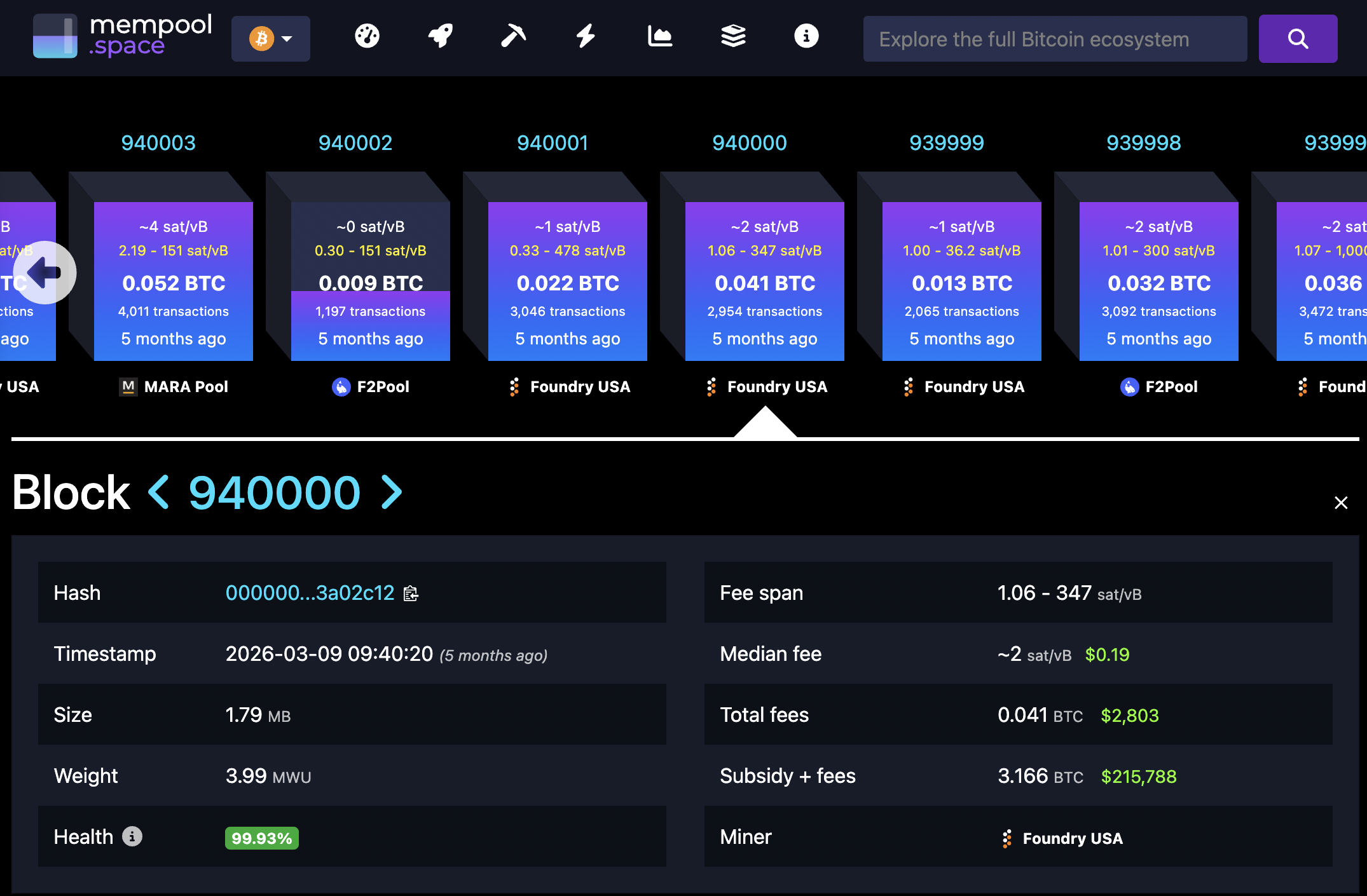
Bitcoin’s supply is the one number every holder knows: twenty-one million, and no more. It is written into the software as a schedule, not a promise, enforced by every node that has ever validated a block. On March 9, 2026, at block 940,000, the network crossed a line that had always been coming. The twenty-millionth bitcoin was mined.
The figure is easy to misread as almost done. Twenty of twenty-one million is roughly ninety-five percent of the supply, issued in about seventeen years. But the remaining five percent is not seventeen years away; it is more than a century away. Bitcoin’s issuance halves every four years, so each future era mints half as much as the last, and the curve flattens into a long asymptote. The final bitcoin is scheduled to be mined around the year 2140. The twenty-millionth coin and the twenty-one-millionth are separated by a single million, and by roughly a hundred and fourteen years.
Nothing happened at block 940,000 that had not been happening at every block before it. No rule activated. The subsidy did not change; it had last changed at the 2024 halving and would not change again until 2028. A miner assembled a block, collected the scheduled reward, and the counter rolled past a round number. The milestone was entirely psychological, which is to say it was entirely the point. Scarcity that is merely scheduled is abstract. Scarcity you can watch tick past a threshold is a story.
There is a quieter honesty beneath the headline. The twenty-million figure is the amount the protocol has issued, not the amount anyone can spend. The fifty coins in the genesis block can never be moved; thousands more were lost to underpaid rewards, discarded drives, and forgotten keys across seventeen years. The true circulating supply sits somewhat below the nominal count, which means the milestone understates its own subject. Bitcoin is scarcer than its own scoreboard.
The catalog already holds the philosophy this event makes concrete. The twenty-one-million cap has its own entry; the halving that enforces the schedule has another. What block 940,000 added was a date on which the abstraction became visible, the moment the thing bitcoiners had always called fixed could be pointed at rather than merely asserted.
The last coins will be mined by people not yet born, in amounts too small to matter to them, under rules written by someone who never gave his real name. The schedule does not care whether anyone is watching. On March 9, 2026, a great many people were.